Fire Safety Research Institute’s Jason Floyd and Jonathan Hodges Honored with the SFPE Foundation’s Jack Bono Award
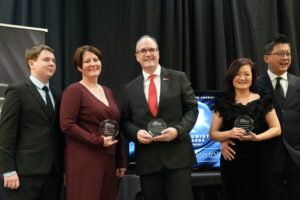
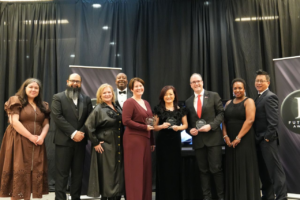
UL Research Institutes is proud to announce that two researchers from its Fire Safety Research Institute have been recognized by the Society of Fire Protection Engineers Foundation for advancing fire engineering methods for modeling pyrolysis. Jason Floyd, Ph.D., an SFPE fellow, and Jonathan Hodges, Ph.D., received the Jack Bono Award for Engineering Communication as part of the Foundation’s 2026 Fire Safety Awards. The award recognizes their Fire Technology article, “An Approach for Flux and Thickness Scaling of Cone Calorimeter Data for Predicting the Pyrolysis of Materials.”
Understanding how materials burn is essential to predicting how fires grow, but it has long been difficult to model in a simple, practical way. Traditional methods either rely on hard-to-find data, use lab results that do not fully reflect real fire conditions, or require highly complex modeling. Floyd and Hodges developed a modeling tool called Spyro to make this work more accessible for engineers. The method uses a small number of affordable lab tests to help predict how a material may burn in fire conditions that have not been directly tested.
The researchers rigorously validated the method across multiple scales: roughly 140 materials in one-dimensional simulations, a single burning item, a stack of wood pallets in a corner, and room-corner tests using plywood or fiber-reinforced polymer at three sizes.
The recognition also carries special significance for UL Research Institutes. The Jack Bono Award for Engineering Communication is named for Jack A. Bono, who spent 44 years at Underwriters Laboratories and served as the organization’s president and CEO from 1978 to 1990. Known as “The Architect” for establishing testing laboratories across the country, Bono devoted his career to advancing public safety through science and engineering.
“This recognition reflects both the impact of Jason and Jonathan’s work and the enduring commitment to safety and scientific excellence that has defined our organization for generations,” said James J. Hudgens, president and CEO of UL Research Institutes. “Having two Fire Safety Research Institute scientists receive an award named for one of the leaders who helped shape our legacy makes this honor especially meaningful.”
It is fitting that an award for engineering communication honors work that reaches the practitioners who depend on it — precisely the purpose of the Spyro method. As Floyd observed, detailed pyrolysis modeling remains an active area of research without clear guidance for practitioners, and “the Spyro approach shows great promise as an engineering method for predicting fire growth that uses readily available fire test methods.”
The foundation will present the 2026 Fire Safety Awards at the SFPE Annual Conference and Expo in Atlanta this October.
This honor affirms the standards ULRI’s researchers uphold and the purpose behind their work: giving the engineers who design our buildings, transportation systems, and everyday products a clearer, more accessible way to ask, “How will this burn?” long before anyone’s safety depends on the answer.

PUBLISHED
Tags