ULRI’s Materials Discovery Research Institute to Collaborate on Autonomous Robotics Research Through DOE Genesis Mission
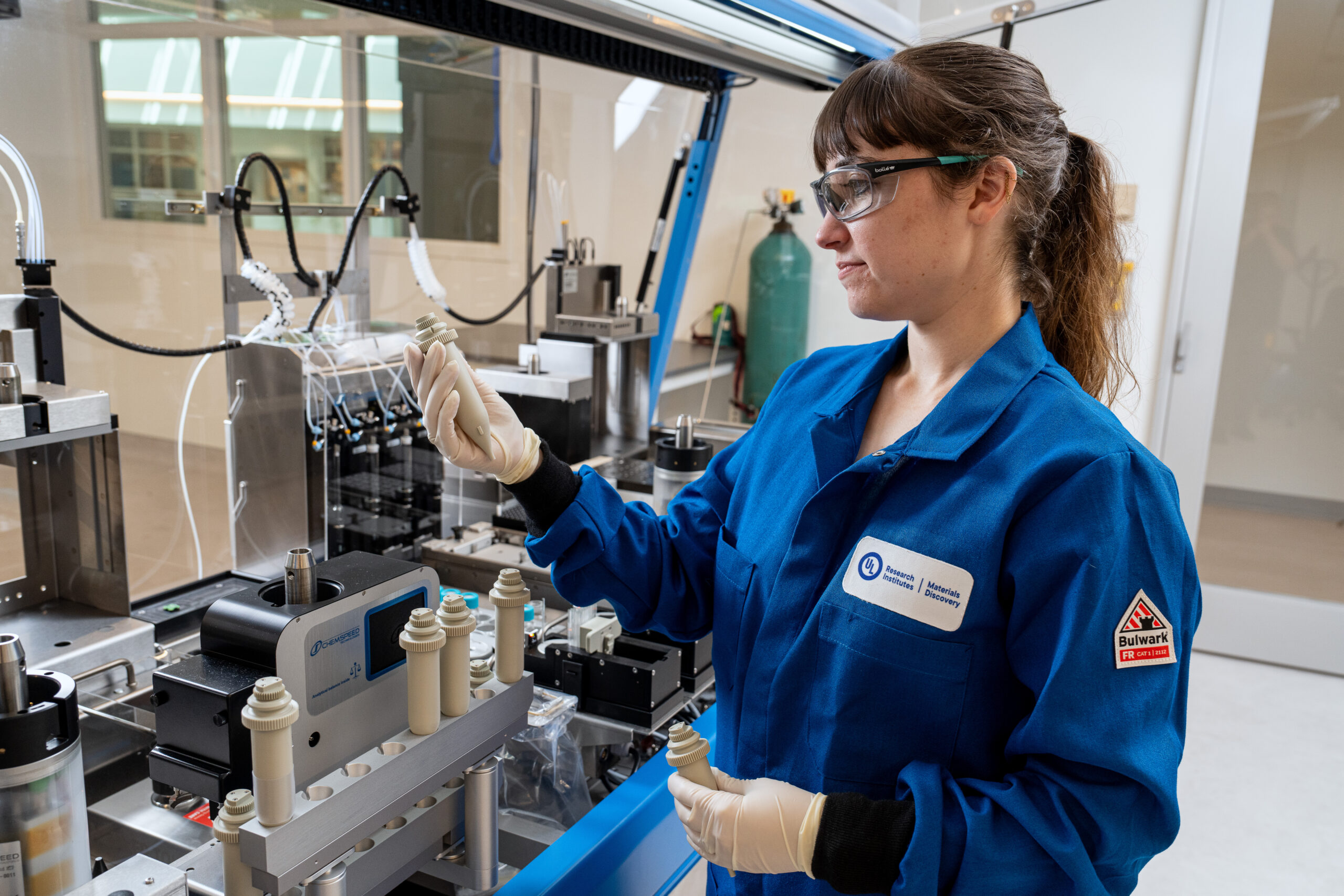
New research is underway to close the gap between robot-assisted experimentation and fully autonomous scientific discovery — aiming to reduce the need for time-consuming physical labor in laboratories, which is a persistent bottleneck in modern experimental research.
While dedicated machinery can automate standardized industrial processes, research workflows in the lab still rely heavily on human dexterity and adaptability. The recently announced SAFE-BOLT project will explore how robots can better understand and respond to real-world laboratory conditions. SAFE-BOLT stands for Safety-Assured Force Aware Execution for Bimanual Operations on Lab Tools.
The University of Texas at Austin’s Department of Computer Science is leading the project in close collaboration with UL Research Institutes’ Materials Discovery Research Institute. The work is funded by the U.S. Department of Energy through a $293 million funding opportunity under its Genesis Mission, an initiative designed to accelerate discovery by combining artificial intelligence, supercomputing, and experimentation.
Despite advances in automation, robots have yet to master uniquely human characteristics like knowing how much force to apply for certain tasks—from turning a jammed knob to spreading liquid across a glass plate. These challenges in perception, force control, and dexterous manipulation currently separate robot-assisted workflows from more fully autonomous experimentation.
By studying the limits of today’s robotic systems and building test environments around practical lab challenges, the project will help create the foundation for AI-guided experimentation that is not only faster, but more reliable and useful for scientists.

The Materials Discovery Research Institute will assist in Phase 1 of the SAFE-BOLT project: building a physical testing lab to capture robotics data. The institute’s materials synthesis and assembly workflows will inform the lab’s infrastructure, experiments, and desired outcomes.
“The Materials Discovery team is helping us identify meaningful laboratory tasks, define performance requirements, and ensure that our research addresses real challenges faced by scientists,” said University of Texas professor Volkan Isler, principal investigator for the SAFE-BOLT project. “This type of close collaboration is essential for developing robotics technology that is both technically sound and practically useful.”
The desire to accelerate scientific discovery through automation aligns with the Materials Discovery team’s digital-first approach to addressing pressing safety concerns. Its accelerated methodologies group is responsible for the automated workflows and advanced robotics that support the institute’s eco-remediation and clean energy research. Led by Asra Hassan, Ph.D., lead research scientist, the group collaborated closely with Isler on the Genesis proposal.
“Robotics is integral to our research,” said Hassan. “Removing tedious tasks from our workflows frees everyone up for more focused research and more thorough testing.”
If selected for Phase II funding, the team would develop and evaluate more advanced algorithms to address the limitations identified during Phase I. The long-term vision is to combine AI-powered decision making and automated experimentation to enable truly autonomous scientific discovery.
“Automation will shepherd in a new era of scientific research,” said Stuart Miller, ULRI vice president and executive director of the Materials Discovery Research Institute. “The faster we can identify, test, and scale new materials, the faster we can deliver safe, reliable solutions and drive a measurable impact on global health and safety.”
PUBLISHED
Tags