Building Bridges to Safer Futures: One Researcher’s Impact on Fire Safety
Not many people can attribute their careers to a chance encounter with a physical ad pinned to a bulletin board.
But in the 1970s, when Daniel Madrzykowski, Ph.D., was a student trying to find his definitive path, an advertisement for a student internship at the National Bureau of Standards’ fire research division sparked what would become a decades-long dedication to the field of fire safety research.
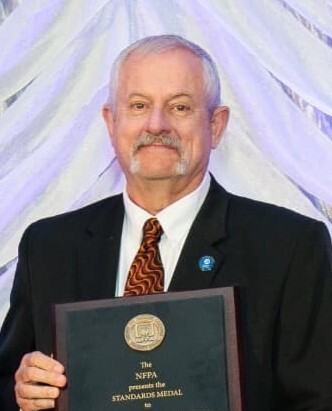
Now, an award-winning leader who has advanced fire safety science for over 35 years, Madrzykowski discussed the trajectory of his career and the impact he witnessed through the evolution of fire safety and research in that time.
Crafting a career, in his own time
One of Madrzykowski’s first test projects at the National Bureau of Standards involved limiting lateral flame spread for insulating materials in homes. At the time, the federal government encouraged residents to put insulation in their attics, even though the insulating materials used and the infrastructure of home attics proved a hazardous combination that resulted in many attic fires.
The testing and research Madrzykowski completed ultimately ensured the insulation used in homes was altered to be more fire resistant in the future. This was also the first of many opportunities he would have to identify a problem, run experiments, document the findings, and write a report that would influence future codes and safety standards, a process that would get him hooked and lead him to take a deeper interest in fire engineering.
Madrzykowski received his bachelor’s degree in mechanical engineering from the University of Maryland. He then spent five years working in the field while concurrently completing his master’s degree in fire protection engineering, also from Maryland. Years later, he earned his Ph.D. in fire engineering from the University of Canterbury.
Madrzykowski said his spaced-out educational path was sometimes a professional roadblock, but he also recognizes it gave him an advantage by keeping him technically sharp and continuously learning.
“If I would have gotten my Ph.D. in quick succession before I was 30, I would have missed out on a lot of technology that’s used for research today,” he said.
Advancements in technology and research tools have driven a notable evolution in fire safety science. For example, Madrzykowski said modern computational power and speed over the past few decades have vastly improved modeling and measurement capabilities in fire research.
Serving the fire service
Guided by a commitment to firefighter safety, Madrzykowski has spent much of his career ensuring advances in fire safety science helped build a bridge to the fire service. As the current senior director of research at UL Research Institutes’ Fire Safety Research Institute, his team’s research has included studying fire behavior topics and the modern fire environment, like the changes in building infrastructures and how fuel loads in residential houses over the past 50 years are leading to faster flashover times.
This has allowed him and fellow researchers to deliver more evidence-based information in the form of tactical considerations on how to better fight a fire and be a more effective firefighter.
“We’ve always had the mindset … we don’t do research for the fire service; we do research with the fire service,” Madrzykowski said.
This knowledge has provided important education and training to the fire service through programs such as the Fire Safety Academy at the Fire Safety Research Institute. His team has also worked with organizations like the National Fire Protection Association to provide a guide to structural firefighting. Still, overcoming the industry’s hesitation in trusting evidence-based tactics hasn’t been without its challenges.
“In the early days, and maybe in some pockets still today, there are folks in the fire service who have adopted the philosophy of, ‘This is how we’ve always done it; we don’t need anything new; everything works,’” Madrzykowski said.
Additional Fire Safety Research Institute training programs have fostered strong relationships and trust with the fire service. Understanding the core of what firefighters are trained to do and tailoring the training with that understanding has been an essential component in building credibility.
Creating a safer future
As part of his research at the Fire Safety Research Institute, Madrzykowski partners with the fire service to study near misses and line-of-duty deaths, in addition to analyzing other fire events for lessons learned.
This work draws on the fire service culture of honoring those who serve, learning from mistakes and making improvements to better keep their brothers and sisters safe on the fireground, and Madrzykowski’s work has made a positive change in the fire service
Madrzykowski has led investigations for incidents involving single-family homes to commercial settings like warehouses. For members of the fire service, seeing what happened and relating it back to science can make the lessons drawn from tragedy lead to adoption of evidence-backed tactics
Reflecting on why that credibility is so valuable, Madrzykowski concluded: “Understanding that firefighters are there for the people who are trapped in the house, life safety is their ultimate priority. That’s what they’ve taken their oath for—to save people’s lives. Understanding how [fire research results] can better help them save people’s lives…is the sticky point that’s going to create a change.”
PUBLISHED
Tags