Celebrating 2025 Winners of the UL Research Institutes’ ASEAN-U.S. Science Prize for Women
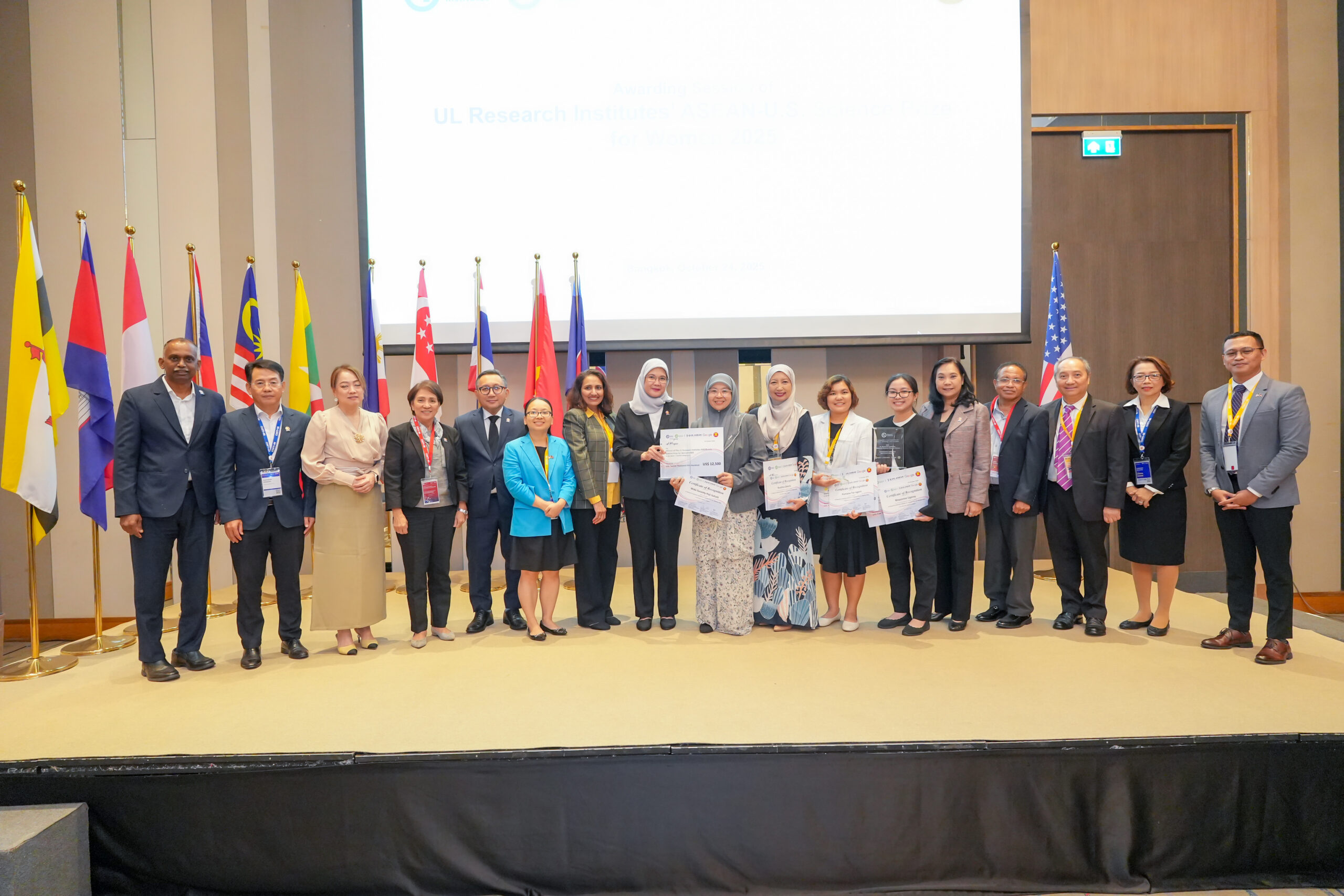
BANGKOK — The Association of Southeast Asian Nations (ASEAN) Committee on Science, Technology, and Innovation (COSTI), in partnership with the US-ASEAN Business Council (USABC), Google, UL Research Institutes, and UL Standards & Engagement, proudly announces the winners of the UL Research Institutes’ ASEAN-U.S. Science Prize for Women 2025.
This year’s Mid-Career Scientist Award was presented to Dr. Pantana Tor-ngern of Thailand for her groundbreaking work in Wireless Forest Water Monitoring for Climate Resilience. The Senior Scientist Award was presented to Dr. Wida Susanty Haji Suhaili of Brunei Darussalam, recognized for her pioneering research in Smart Water Management System using IOT for Disaster Management and Food Security in Brunei Darussalam. In addition, Dr. Mayzonee Ligaray of the Philippines and Dr. Rozalina Zakaria of Malaysia received Honorable Mentions for their innovative contributions in smart water management. The Mid-Career and Senior Scientist winners will each receive USD 12,500, while Honorable Mentions will receive USD 5,000.
Now in its eleventh year, the Science Prize for Women celebrates the vital contributions of women scientists across ASEAN. The 2025 theme, “Generative AI – Smart Water Management,” highlights how women leaders in science are harnessing artificial intelligence to address pressing water challenges, from improving water quality and efficiency to building climate-resilient communities.
“We would like to congratulate this year’s winners of the UL Research Institutes’ ASEAN-U.S. Science Prize for Women,” said Dr. Boediastoeti Ontowirjo, chair of the ASEAN Committee on Science, Technology, and Innovation (COSTI). “As we celebrate the eleventh year of the Prize, it reflects an essential platform to showcase the invaluable work of women scientists in driving innovation and sustainable development across our region.”
“We extend our sincere congratulations to this year’s award recipients in recognition of their outstanding contributions,” said Chris Cramer, executive vice president and chief research officer at UL Research Institutes. “Their achievements embody the spirit of innovation and societal impact that this prestigious prize seeks to honor. We deeply appreciate the valued collaboration of ASEAN COSTI, the US-ASEAN Business Council, Google, and UL Standards & Engagement, and we look forward to continuing this important partnership in the years ahead to further advance scientific research and innovation.”
“The US-ASEAN Business Council and Google are honored to partner in this initiative,” said Ambassador (Ret.) Brian McFeeters, interim president and CEO of the US-ASEAN Business Council. “The Science Prize for Women demonstrates the importance of empowering women scientists whose innovations not only advance technology but also strengthen economic resilience and sustainable growth across ASEAN.”
“We extend our warmest congratulations to all winners,” added Wilson White, vice president, Government Affairs & Public Policy, Google Asia Pacific. “Their groundbreaking research illustrates the transformative potential of AI in tackling regional challenges like water management and reflects the importance of supporting women leaders in science and technology.”
The ASEAN Secretariat, together with USABC, Google, UL Research Institutes, and UL Standards & Engagement, remains committed to recognizing and promoting the impactful research of women scientists across ASEAN. Over the past decade, the Science Prize for Women has served as a prestigious platform to inspire the next generation of women innovators to drive solutions to pressing global challenges and advance a more sustainable future across ASEAN and beyond.
About the ASEAN–U.S. Science Prize for Women
Established in 2014, the ASEAN–U.S. Science Prize for Women recognizes outstanding mid‑career and senior women scientists from ASEAN member states whose research demonstrates leadership, innovation, and societal impact. Organized in collaboration with the ASEAN Committee on Science, Technology, and Innovation (COSTI) and long‑standing public‑ and private‑sector partners, the prize has become a respected regional platform for advancing scientific excellence and gender equity. Over more than a decade, the program has evolved to reflect emerging scientific priorities across Southeast Asia. Across its cycles, the prize has highlighted research in areas including climate resilience, clean energy and electrification, artificial intelligence, smart infrastructure, and data‑driven environmental solutions, while strengthening cross‑border collaboration and elevating women as leaders in science and engineering.
Learn about ASEAN U.S. Science Prize themes and winners from previous years
For the full list, more information and links to additional presentations from the winners, visit scienceprize4women.asean.org.
2024 — Climate Resilience and Adaptation
Senior Scientist Award: Dr. Lam Yeng Ming (Singapore) — Nanostructured functional materials to improve soil water retention and climate resilience.
Mid‑Career Scientist Award: Dr. Daphne Teck Ching Lai (Brunei Darussalam) — Data science and AI applications for forest monitoring, water quality analysis, and green energy.
2023 — Electrification
Senior Scientist Award: Dr. Pimpa Limthongkul (Thailand) — Energy storage research for electric vehicles and power grids, including battery‑swapping platforms.
Mid‑Career Scientist Award: Dr. Charlle L. Sy (Philippines) — Micro‑hydro systems for electricity generation using advanced mathematical modeling.
2022 — Artificial Intelligence in Health and Safety
Senior Scientist Award: Dr. Sok Ching Cheong (Malaysia)
Mid‑Career Scientist Award: Dr. Supiya Charoensiriwath (Thailand)
2021 — Scientific Leadership and Innovation Across STEM disciplines
Senior Scientist Award: Dr. Neni Sintawardani (Indonesia)
Mid‑Career Scientist Award: Dr. Li Hongying (Singapore)
2020 — Scientific Excellence and Regional Representation
Winner: Dr. Yoke Fun Chan (Malaysia)
PUBLISHED